It was not just a bandanna. It held together an edifice of recollections that kept her going, and it was something more than that as well.
“Mama! Mama! Are you listening to me?” Adara’s voice couldn’t pull her back from the tide of cascading memories that flowed through her mind like a favorite yet tragic movie replayed endlessly. Adara placed her small hands on her mother’s shoulders, steadying her, helping her return from the faraway places in her mind.
“What are you thinking, Mama?” she asked with her usual expression, that bright mixture of attention and excitement.
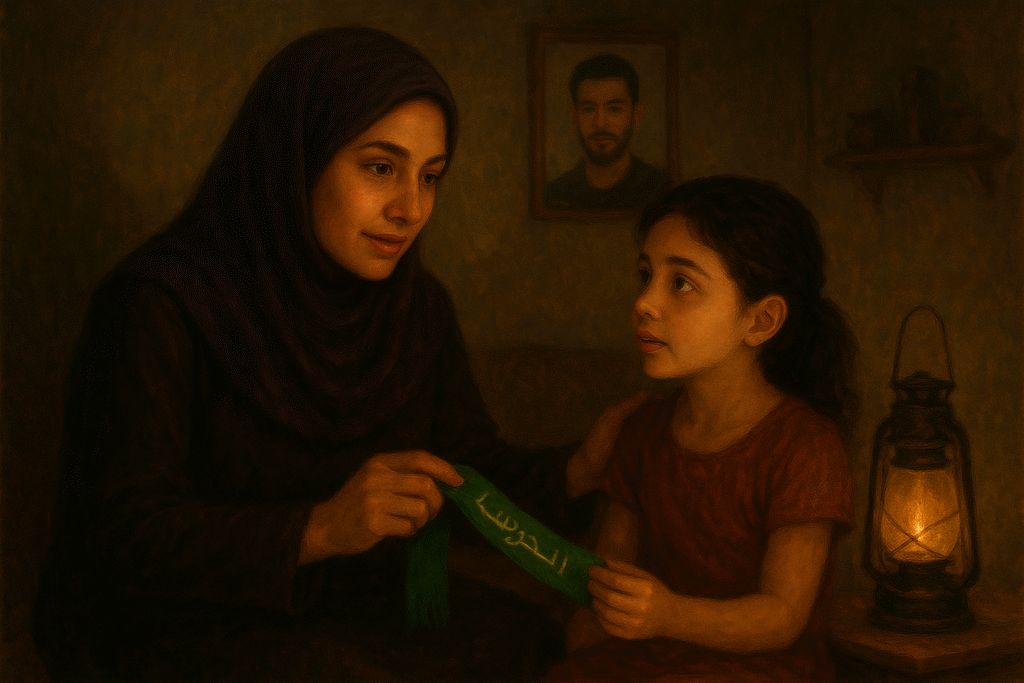
Salma swallowed the heaviness in her throat, brushed Adara’s hair back, and placed her palm gently on her forehead, as though mapping the contours of her daughter’s face awakened the presence of Samir. Her gaze drifted to the green bandanna as though it pierced through the walls of their small home, reaching back across years into something vivid and beautiful.
“You know… this was Samir’s bandanna. But it was earned by him through his struggle, though, if I had a choice, I would not let him do it again.” She sighed. “The paths we choose often begin at crossroads of impossibly difficult possibilities. Dignity, patriotism, collective struggle, they sound like noble ideals when spoken in isolation. But when they stand against equally sacred obligations of family, they become far more complicated.”
Her voice lingered. “After our marriage, a few strangers began coming to our house. They were good men, religious, but they carried with them an air of strangeness, as if they belonged to another world entirely. They spoke of struggle, of dignity, of faith. And Samir listened.”
He began attending their gatherings, coming back each night more absorbed in their vision. He told me of sacrifice, of living only for the cause. I would ask, frightened, even if that sacrifice demanded my life, or the lives of our children?
It was too heavy a question for him to answer. He would look away, change the subject, but I already knew his answer. He was ready to sacrifice everything, even me, even the generations to come. He lacked the strength to say it aloud, but I did not press again. I knew we all had to offer ourselves to this struggle. Whether we would succeed was another story. But our resistance to oppression was what gave us our identity, and what consumed it too.
Adara clutched the green band tighter, studying the faded script. “Who were they, Mama?”
“They were the ones who called themselves Ḥarakah al-Muqāwama al-Islāmiyya, the Islamic Resistance Movement. Hamas, as the world came to know them. They were born, my daughter, in the incubator of oppression, out of the suffocating weight of occupation and humiliation.”
Adara frowned, puzzled. “But Mama, why were they against other Palestinian groups? Weren’t they fighting for the same cause?”
Salma placed her hand over Adara’s, her eyes suddenly alive with the fire of memory. “Because, habibti, when Hamas was founded in 1987, during the First Intifada, our people had been waiting too long for deliverance. Older factions like Fatah and the PLO spoke of negotiations and international agreements, but they failed to stop the settlements, the prisons, the checkpoints. Hamas offered something different. They wrapped resistance in the cloth of faith, and they gave people a sense of dignity.”
Her voice grew steadier, carrying both conviction and sorrow. “They built schools and clinics, fed the hungry in the camps, and gave hope where there was none. But they also carried arms, and they declared openly that Palestine was not to be divided, not even an inch. They embodied the cry: ‘From the river to the sea, Palestine will be free.’ That boldness drew many, including your father.”
She paused, breathing deeply, as memory drew her into the crowded alleys of Gaza, the whispers of secret meetings, the charged energy of young men ready to sacrifice. “When the elections came in 2006, Hamas surprised the world. They won. The people were tired of Fatah’s corruption and broken promises. They placed their trust in Hamas, believing justice would follow. But their victory split our nation. In 2007, they seized Gaza from Fatah by force. Since then, this strip of land has been under their rule. They fought other Palestinian groups with the same ferocity they used against Israel, convinced that anyone seeking compromise was betraying the cause.”
Adara leaned closer, her eyes wide. “And Israel, Mama?”
Salma’s expression dimmed, the weight of reality pressing back. “Yes, my daughter. They fought Israel with rockets, with tunnels, with boldness that shook even their enemies. They made the world see that Palestinians could not be erased. But every act of defiance brought fire upon us. Every war, every blockade, every child buried too soon. We carried that cost. And yet, for your father, for many like him, that green band was not just cloth. It was a promise, a promise that Gaza would never bow.”
The room grew quiet. Above them, the faint drone of unseen machines circled in the night sky. Mother and daughter sat together, holding the band between them, a fragile thread of identity, memory, loss, and an unbroken will.
“It was after two years of our marriage,” Salma continued softly. “By then, Samir had formally joined the al-Qassam Brigades. He was already in the crosshairs of Israeli intelligence. He would vanish for weeks at a time, returning in the middle of the night. For me, those brief moments together were all I could grasp.
I did protest. I told him, sometimes in tears, that he was betraying my love. But he would only smile faintly, look at me with a gaze so piercing that I would relent.”
She drifted again into memory. “It was a summer evening, nearly ten years ago. Hamas held full control over Gaza then. Families tied to its military or administrative wings carried a sense of privilege, of pride.
Iqra, my childhood friend, lived nearby with her husband Khalid. We spent much time together. Khalid treated me like his own sister, helping with my household whenever Samir was gone. Iqra and I cooked together, and when she was expecting her first child, I cared for her. When Qasim was born, she was radiant with joy and wished the same for me. Just thinking of having my own children gave me butterflies.”
Salma’s voice trembled. “And then that day finally arrived. I was dying to tell Samir, but he disappeared for three weeks. When he finally came, it was in the middle of the night, slipping in through the window like a thief. I had fallen asleep on the sofa after waiting for him, food still laid out on the table.
He sat beside me quietly, holding my hand until I stirred. When I opened my eyes, he was smiling down at me. Samir’s thick eyebrows, set against his fair complexion, gave him an air of confidence and control. It was difficult to look into his eyes for long. I buried my face in his chest instead.
‘What’s the matter, Sally?’ he asked, using the nickname he loved. I stayed silent, pressing myself deeper into him. But he knew, he always knew.
‘If you don’t want to tell me, I’ll leave. I won’t even eat what you cooked,’ he teased.
I finally whispered it, muffled against his chest. ‘You are going to be a father.’ The words flew from me like an arrow released unexpectedly.
Samir lifted my face, kissed my forehead, and said instantly, ‘It’s a girl, and we shall call her Adara. She will be majestic, like you, Sally.’”
Adara’s eyes gleamed at the memory, as though her father’s spirit touched her through her mother’s voice. “Mama! Did he give you a gift after that?” she asked mischievously.
Salma smiled faintly, inhaling as if to step back into the past. “The next day, he took me to dinner at Deir al-Balah resort. We sat overlooking the Mediterranean Sea. Samir spoke of how that sea had carried so many armies, so many invasions, and yet still looked calm and beautiful despite all the blood spilled in its depths. ‘Just like us, the Palestinians,’ he said. ‘Decades of oppression and dispossession have not marred our beauty. We are still the most attractive people of the world, and one of them is sitting in front of me.’ He teased me just to draw me back from staring too long at the sea.”
Her lips tightened. “I did not have many such moments with Samir, but those I did have still live inside me. I can touch them as if they were yesterday.”
And then, without warning, the world shattered. The kerosene lantern flickered as the house shook from a sudden blast. They stumbled outside into chaos. Smoke thickened the air until it was impossible for Salma to hold Adara’s hand firmly. She pulled her forward blindly, searching for safety, until she heard a voice calling her name through the haze.
“Salma! Salma! Salma!”