From the Soul’s Pulse to the Digital Circuitry of Feeling
Part I – A Moment in Stillness
Walking on a calm evening with my spouse, I found myself relishing the quiet beauty of nature. The air was soft and still, the sky glowing with an orange hue as if it had finally stretched its wings after days of relentless rain. Fridays in big cities often feel different and quieter in residential enclaves since many families prefer dining out beyond the bounds of the society. The sound of a basketball striking the hard floor echoed distinctly, while a few teenagers nearby attempted to play tennis with more enthusiasm than skill. My wife and I moved at an unhurried pace, savoring the rare gift of stillness, as our children played a short distance away. My eldest son, slightly unwell yet firm in his usual bossy way, had convinced his younger brothers to abandon basketball and instead wander idly around the open gym. Their laughter, mixed with the patter of running feet, formed a melody of its own, one that the noise of city life so often drowns out.
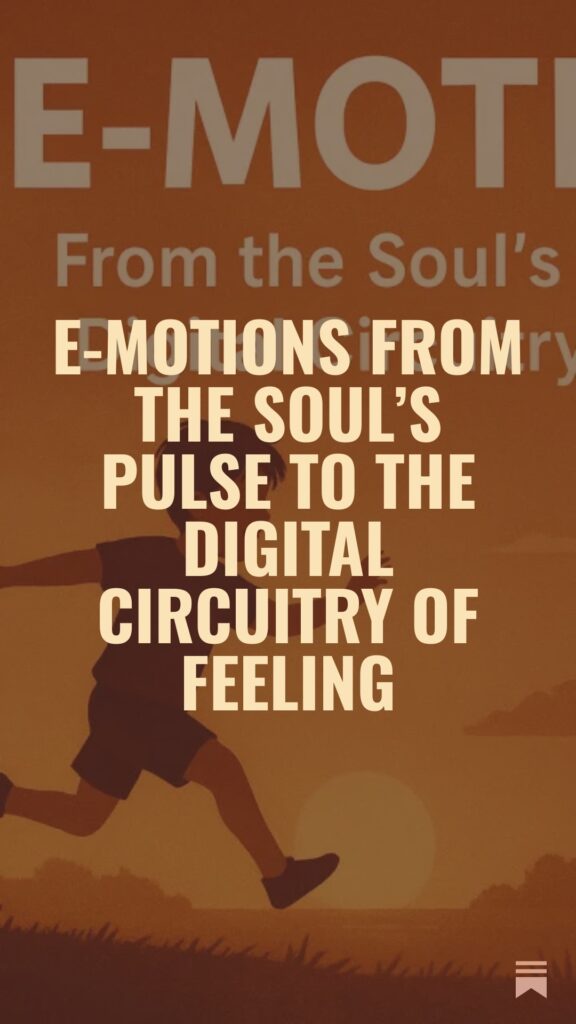
My youngest son, just seven, darted into view. He wasn’t running toward anything in particular. Only leaping, skipping, and spinning in the carefree rhythm that only children seem to master. His joy was unprompted, uncalculated, free of any purpose other than the sheer delight of being alive in that moment. I found myself watching him, as though everything else had melted into background.
It did not come as a passing thought but as a sudden wave that overwhelmed me, an emotion in its purest form. A profound, almost unbearable tenderness, a love so intense that it surged through my nerves like electricity running through a wire. It was not a feeling I created, nor one I chose. It moved through me like a flowing stream, carrying me helplessly along its force.
I pointed out to my wife the simple play of nature, while I lingered in that sensation for a few moments, holding it and marveling at how emotions are forces that carry us from stillness into movement, from thought into feeling, from distance into closeness. Yet as the wave receded, another realization surfaced: how rare such unmediated moments have become!!
Part II – The Nature of Emotion
Psychology reminds us that emotions are not just fleeting moods. They are the primal forces that guide our survival and shape our humanity. From Darwin’s insights into emotional expressions as evolutionary signals to modern neuroscience’s mapping of the brain’s limbic system, emotions are revealed as energy in motion. They propel us into action before thought can intervene. Fear quickens the pulse. Joy loosens the muscles. Anger primes us for defense. Love binds us into lasting bonds.
But what struck me that evening was not the science but the simplicity. Emotions move us because they are meant to move us. They carry us across the divide between self and other, reminding us that we are not closed systems but open beings shaped by connection. And yet, in the digital age, these primal currents often encounter filters, distortions, and reprogramming.
Part III – Platforms of Feeling
Most of us now experience emotions through the lens of screens. Social media platforms do not simply reflect our feelings, they actively shape them.
On Facebook, nostalgia is monetized. Old memories resurface through “On This Day” reminders, turning sentimentality into a cycle of re-engagement. Instagram thrives on envy and aspiration. Carefully curated images of vacations, lifestyles, and bodies nudge us toward comparison, with likes serving as currency for validation. Twitter, or X as it is now branded, fuels outrage. Its architecture thrives on brevity and speed, compressing complex emotions into bursts of anger that trend faster than reason can catch up. TikTok, perhaps the most visceral of all, thrives on immediacy. Short clips spark laughter, tears, or shock in seconds, harnessing raw emotional reflexes to keep us endlessly scrolling.
These platforms do not ask how we feel. They decide how we will feel. And in that orchestration lies a subtle but profound theft of agency.
Part IV – The Politics of Emotion
Power has always rested on emotions. Empires have risen on pride and collapsed in fear. Today, political actors weaponize emotions with surgical precision. Campaign strategists analyze data to trigger outrage, nationalism, or hope. Fear of the other becomes a rallying cry. Anger toward elites fuels movements. Optimism is staged as spectacle.
Digital platforms magnify this effect. An angry tweet spreads faster than a calm argument. A tearful video resonates more widely than a measured policy paper. What was once propaganda has become algorithmic populism, where feelings decide fates long before facts are considered.
Part V – The Commodification of Feelings
If the political sphere thrives on collective emotions, the marketplace profits from individual ones. Late capitalism has turned our most intimate experiences into sources of revenue, offering to manage, soothe, or amplify our emotions in exchange for payment.
Meditation platforms monetize serenity, selling calm through subscription models. Music streaming apps package moods into ready-made playlists, turning emotions into commodities. Influencers on Instagram and TikTok trade not only in products but in curated emotional atmospheres, selling aspiration and envy in equal measure.
Neil Postman once warned that modern culture was collapsing into entertainment. Today, even our emotions have become entertainment, processed, packaged, and marketed back to us.
Part VI – Towards an Ethics of Authentic Emotions
If our emotions have been digitized, politicized, and commodified, the question remains: what is left of authenticity? Can we still feel in ways that are not pre-programmed by platforms or packaged by markets?
Byung-Chul Han describes our age as one of exhaustion, where even joy becomes a duty, captured in curated smiles and hashtags. Mark Fisher saw despair itself co-opted, reframed as private illness rather than collective malaise. Both point to the same crisis: that our emotions, once spontaneous, are increasingly disciplined into predictable patterns.
Yet resistance is still possible. To reclaim authentic emotion requires slowness. To feel without posting, to love without measuring, to grieve without broadcasting. Art, literature, silence, and spiritual practice remain sanctuaries where emotions can unfold without metrics. To live emotionally outside the feed is a political act, a refusal to let markets or algorithms define what it means to be human.
Part VII – Conclusion: Reclaiming the Soul of Motion
That evening walk with my wife and children lingers in memory not because it was extraordinary but because it was unfiltered. My son’s carefree leaps were not meant for a camera nor for an audience. His joy was raw, uncurated, untranslatable into icons or posts. The emotion that surged within me was just as unmediated, a silent wave of love, overwhelming in its purity.
Perhaps that is what makes such moments so rare. In an age where emotions are constantly pulled into circulation, it takes effort to let them simply be. To feel without capturing. To experience without sharing. To let motion arise from the soul before it is tagged as e-motion.
To reclaim our emotional lives does not mean rejecting technology outright. It means creating spaces where joy, sorrow, and love breathe freely, where they are not measured by likes or harvested for data. It means remembering that emotions are not commodities but forces of connection that bind us to one another.
In that instant with my son I was reminded that beneath the feeds and metrics the human heart still pulses with an energy no algorithm can own. To honor that pulse is to honor life itself.
Our task is simple though not easy. To protect the soul of motion from dissolving into e-motion. To let love remain more than a sticker, joy more than a playlist, grief more than a data point. For in these unmediated emotions we rediscover our humanity and our hope.